A year of bold conversations, blunt truths, and big questions.
Let’s be honest: 2025 didn’t offer easy answers. But it did offer something better… perspective. Across six DesignMeets and Café Talks events this year, designers, thinkers, public servants, provocateurs, students and educators gathered to wrestle with some of the thorniest questions facing design today. What’s our role in shaping the future? What tools—and systems—are shaping us? And can design, in the thick of it, sleeves rolled up, grappling with messy systems, entrenched silos, new technologies, help answer the question of what kind of future we want to build.
With topics that ranged from AI to Canadian identity, leadership to language, this year’s DesignMeets and Café Talks speakers weren’t interested in design for design’s sake. They were after something more ambitious and more ambiguous: a way to help organizations not only function better, but be better. And across the varied subject matter, the year’s conversations revealed some shared themes and surfaced a few signals that might just define where we go next.
Designing in Complexity
At the heart of the series was a persistent tension: between urgency and emergence. Clearly across sectors, scales, and mandates, design is no longer the kid at the strategy table or an afterthought part of the furniture. Indeed, as OCADU Dean of Design, Lesley Ann Noel so succinctly opined, “Designers don’t need to be given a seat at the table. We can build our own tables.”
Whether building policy for government, programs for healthcare, or experiences inside financial institutions, designers are being asked to solve for complexity. And not in theory. In the real world, and a messy one at that.
From the Future of Design Teams panel, one theme stood out: design maturity doesn’t mean things get easier; it means they get more integrated. We’re not just creating artifacts anymore, we’re redesigning service experiences, ways of working, entire systems. And that comes with different expectations and new vulnerabilities.

Human, First
DesignMeets doesn’t do hype. And nowhere was that more obvious than in the year’s final panel on AI and Human-Centred Design.
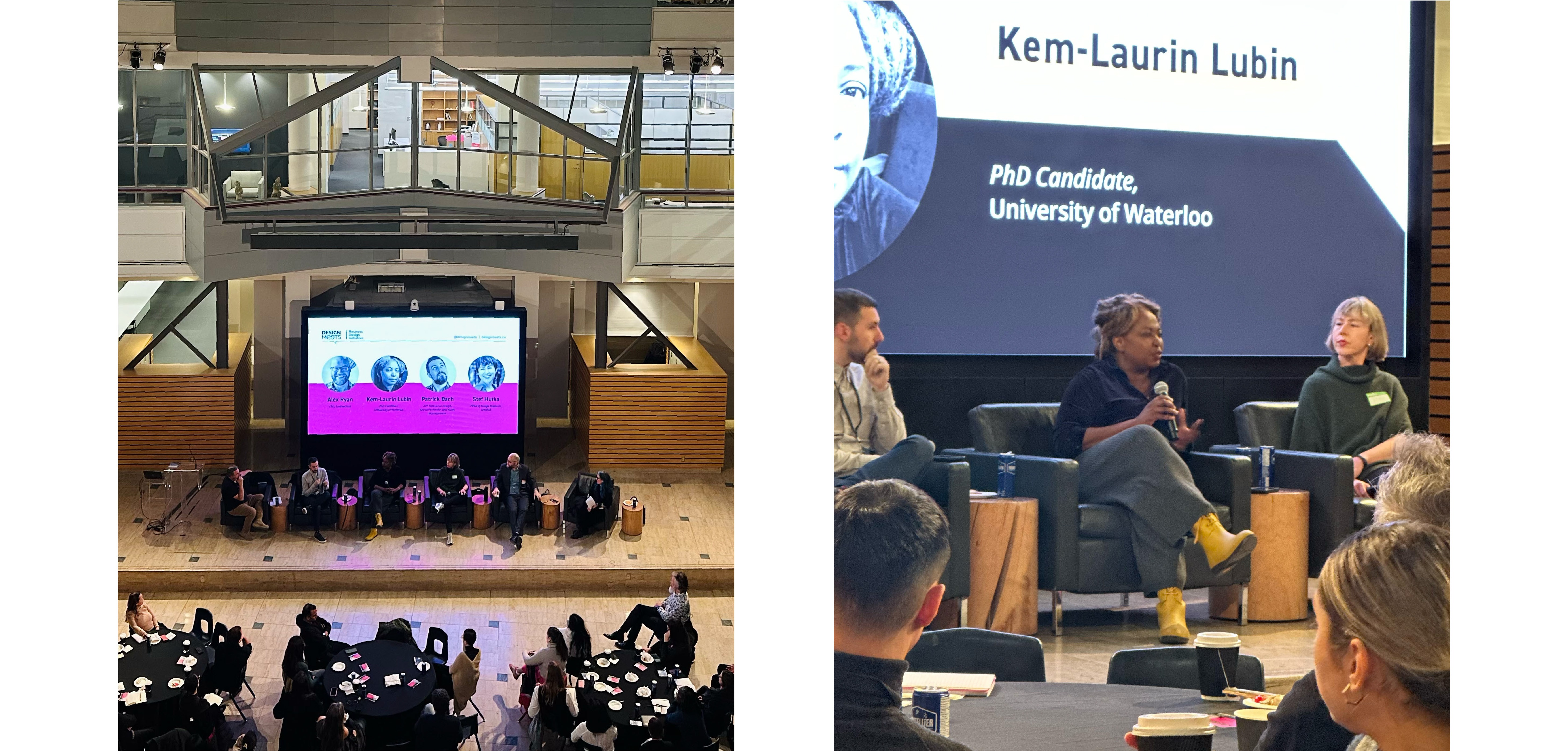
Yes, AI is a powerful tool. No, it can’t replace empathy, intuition, or the deep contextual awareness that human-centred design demands. As Kem-Laurin Lubin put it, “When we start centering tools, we risk decentering people”.
Instead, panelists called for AI practices grounded in lived experience and ethical clarity. Stefanie Hutka warned that when we skip over nuance, we produce “vague ethics and vague outcomes”. That is not exactly the legacy any of us are hoping for.
The Design Leadership / Management Disconnect
Leadership was a throughline in many of this year’s conversations, and it rarely came in the form of hierarchy.
At The Future of the Design Practice, panelists emphasized that design leaders are often system stewards, not just team managers. The role requires translation between strategy and implementation, risk and innovation, stakeholder and community. To sum up one panelist, ‘It’s about holding the vision and the mess at the same time.’
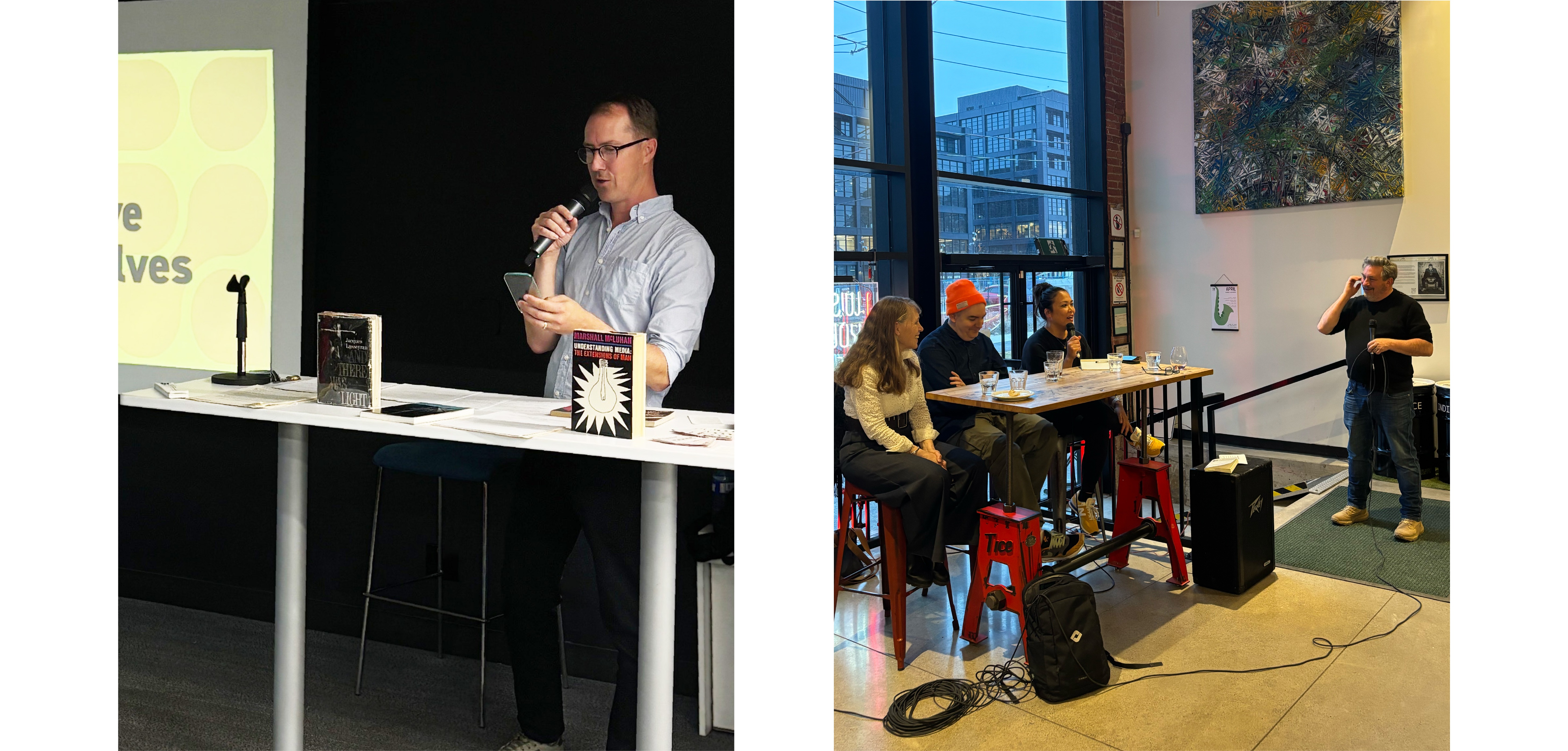
And at Design Can Save Us From Ourselves, Andrew McLuhan reminded us that leadership also means seeing the larger media and technological ecosystem designers operate within. “We make tools, but tools also remake us,” he said, riffing in the dry, philosophical tone only a McLuhan could pull off. Continuing, he ushered another McLuhan-esque warning, “If we don’t comprehend how our tools shape perception, someone else will: marketers, propagandists, platforms. Designers must become literate in their own influence.”
Identity is a Design System
At the What Makes Canada, Canada? event the question wasn’t about symbols. It was about systems.
What emerged was a deeper discussion about belonging, plurality, and participation. How do we design a national identity that reflects everyone, not just a mythic majority? What stories get platformed? What stories stay buried?
Cultural practitioners urged designers to move beyond aesthetic representation into co-creation and equity-centred design. It’s not just about inviting voices in—it’s about building systems where those voices can influence outcomes.

Signals Worth Watching
Some of the ideas showed up once or twice, and they stuck with us.
- The risks of AI flattening learning: Multiple panelists warned that over-relying on AI in creative workflows might strip away the trial-and-error learning so critical to junior designers.
- Designers as diplomats: In complex orgs, the best designers are often the ones who can translate between product, policy, and people to build bridges, not just prototypes.
- Co-design isn’t just a method, it’s a mandate: Especially in public sector and healthcare projects, co-design continues to show up as a non-negotiable, not a “nice to have.”
Looking Ahead
If 2025 had a thesis, it might be this: Design is growing up. And with that comes responsibility.
We’re no longer just solving problems. We’re shaping the systems around them and being shaped in return. We’re asking the question ‘what if?’ embracing Speculative Design to challenge current assumptions and fuel debate about technology and ethics. That calls for humility, collaboration, imagination, critical thinking and yes, the occasional existential panel discussion. Because the future of design is not just about craft or capability. It’s about character, and the willingness to show up, ask hard questions, and keep going, even when the path isn’t clear.
Thanks to everyone who joined us this year—on stage or in the audience. And a big thank you to our community collaborators: Michael Dila, Emma Aiken-Klar, Ethica Coffee Roasters, OCAD University, Henderson Brewing Company, and Rotman Business Design Initiative (BDI). We hope to see you all in 2026, when we’ll keep asking the big questions, challenge our assumptions, and explore what it really means to make the world better by design.
—
Your feedback matters
Share your thoughts to help shape future DesignMeets events.